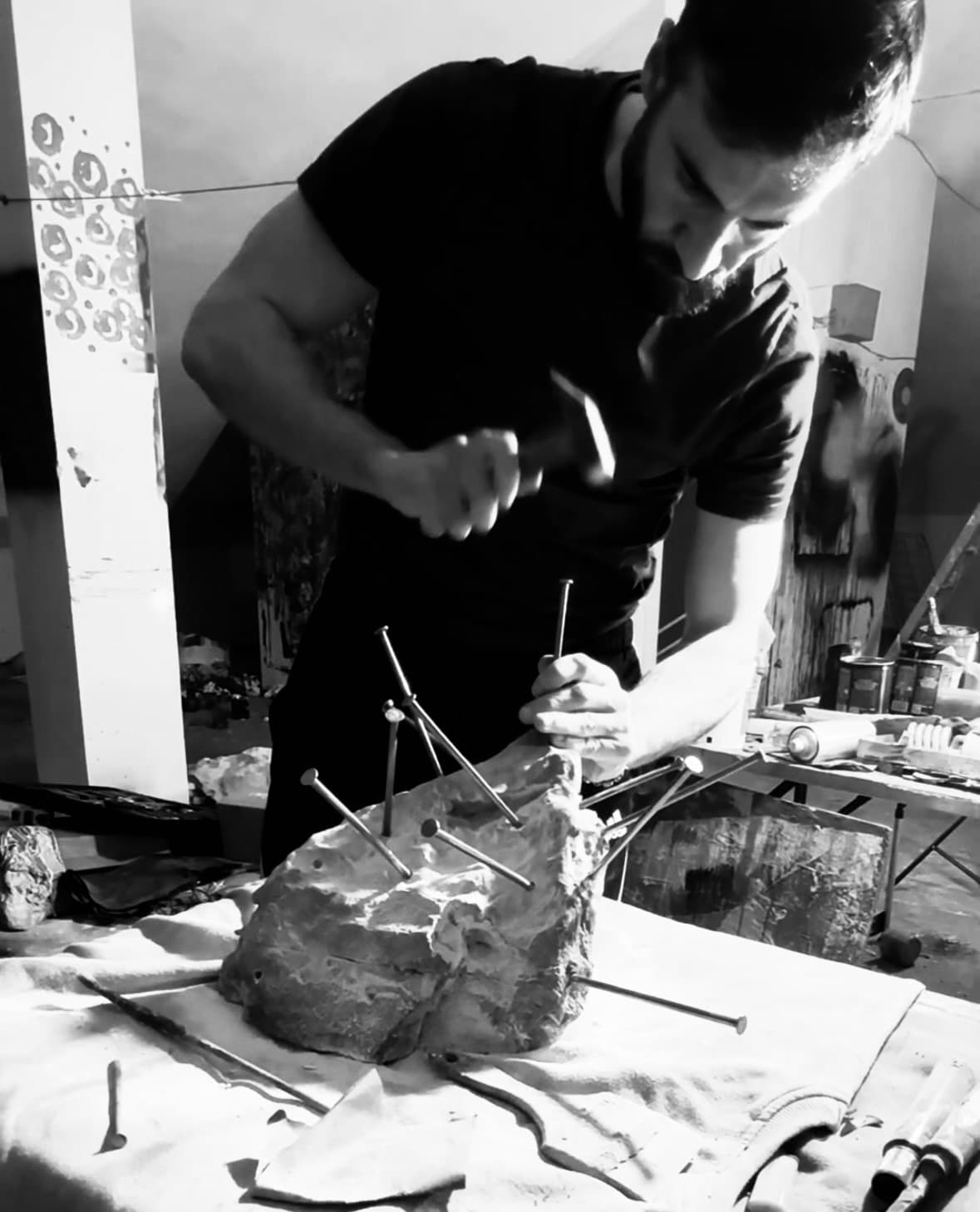
From Sound to Surface: A Biographical Trajectory
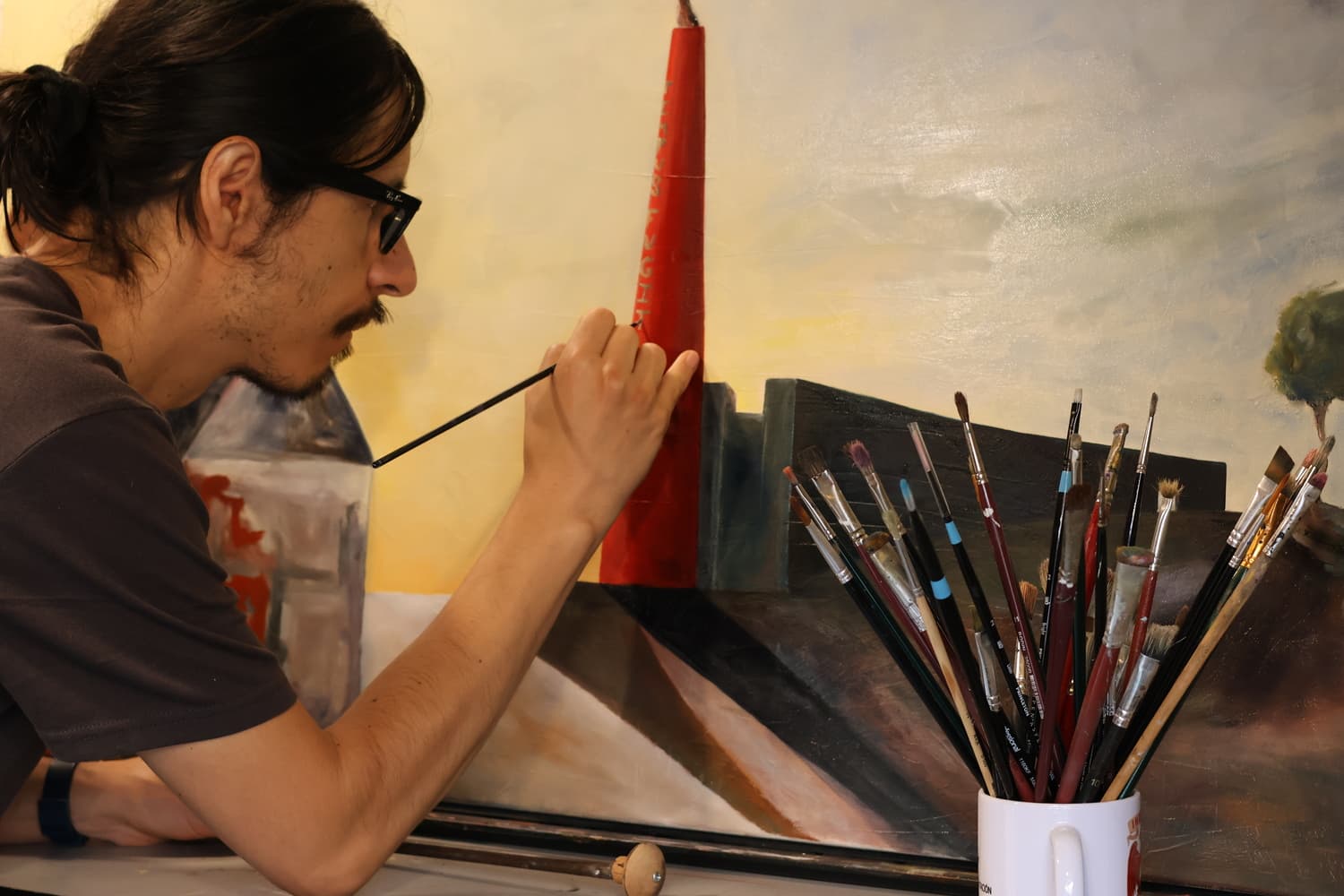
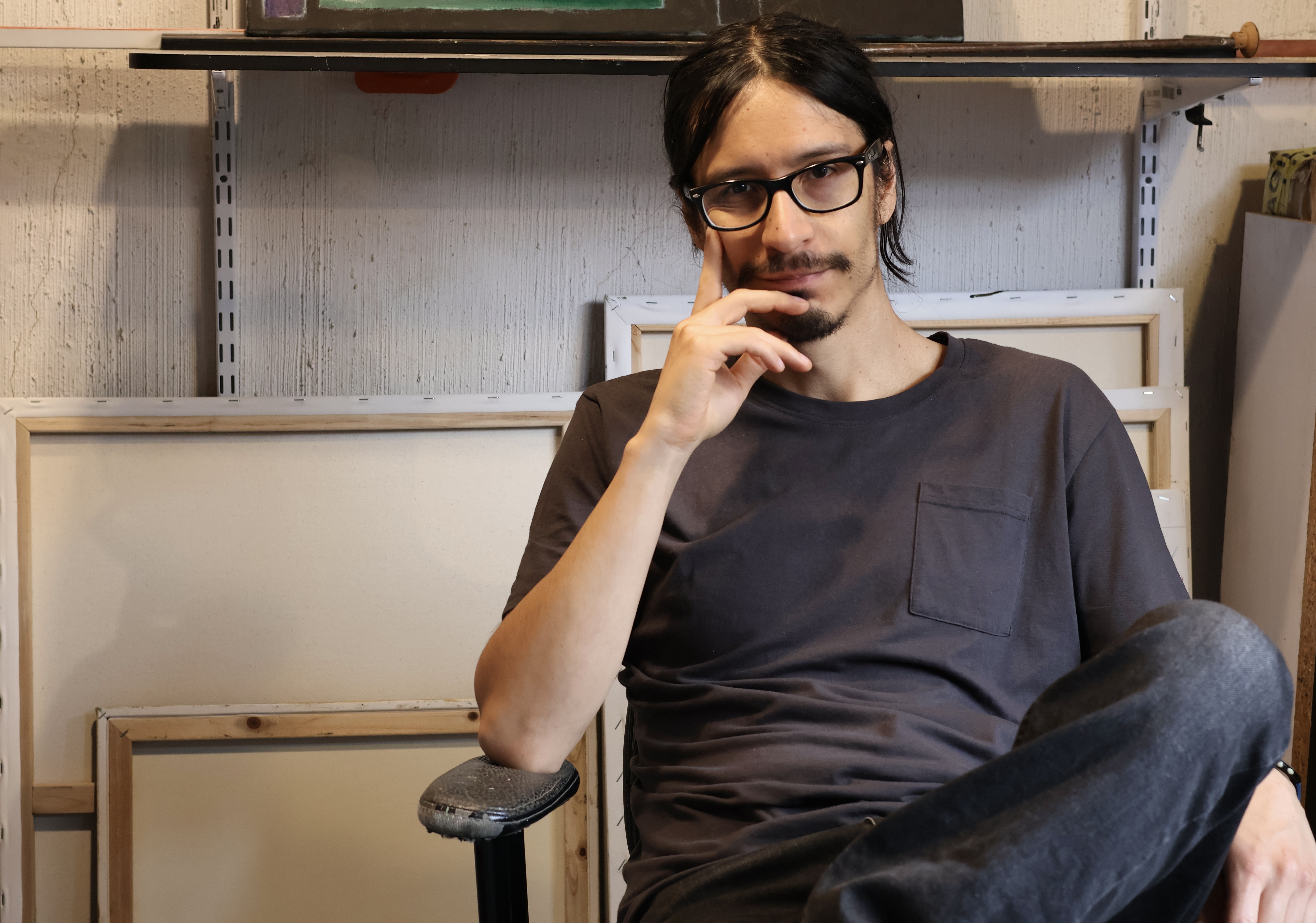
Frank Werner, born in Mexico in 1989, occupies an unusual position among contemporary painters: his visual practice emerged not from a conventional art-school pedigree, but from a prior career devoted to music. As a child, Werner was drawn to drawing landscapes, machinery, and rural scenes, shaped by early exposure to museums, books, and domestic craft objects. That early visual sensibility receded during adolescence, displaced by a formal education in music and subsequent years spent composing and performing. It was only when the music industry's shifting economics rendered that path untenable that Werner returned, almost by accident, to visual art, first through a clay workshop and ultimately through painting.
This trajectory is significant for understanding his mature work. Werner did not arrive at painting through the conventional discipline of life drawing or academic colour theory; rather, he arrived through tactility the clay workshop's demand for translating idea into physical object and through an intuitive recognition that painting, unlike the collaborative and increasingly precarious terrain of the music industry, offered him unmediated creative autonomy. He later sought formal mentorship under an established painter, a relationship he credits as instrumental to refining a vision he already possessed rather than imposing one upon him. This detail is worth noting for critics: Werner's formation resists the standard narrative of academic lineage, situating him instead within a tradition of late-blooming, self-directed painters whose technical fluency was built in service of a pre-existing conceptual urgency.
His choice of medium followed a similar logic of discovery through correction. He began with watercolour for its immediacy, having initially regarded oil painting as technically prohibitive burdened by solvents and slow drying times. Guidance from more experienced painters dismantled this assumption, and oil became his primary medium precisely because its working properties permitted sustained experimentation and revision, qualities that align with the deliberative, layered nature of his compositions.
Philosophical Foundations: Beauty, Duality, and the Weight of Time
Werner's stated artistic concerns harmony, balance, duality, order, tension, and chronological time are not incidental motifs but structural principles that recur across his output with the consistency of a compositional grammar. He has been explicit that these preoccupations are, for him, inseparable from his earlier life in music, suggesting a cross-disciplinary sensibility in which rhythm, interval, and resolution translate from the auditory to the visual register. This is a productive lens through which to assess his paintings: compositions that might otherwise read as surreal juxtaposition can instead be understood as visual counterpoint, with recurring forms functioning analogously to musical motifs.
His declared influences, Paul Klee foremost among them, alongside Rudolf Hausner, Max Ernst, Yves Tanguy, Gerhard Richter, and Jean-Michel Basquiat, situate him within a lineage that bridges early twentieth-century Expressionism and Surrealism with the material and conceptual concerns of later twentieth-century painting. Klee's influence is particularly legible in Werner's willingness to treat the pictorial surface as a field of symbolic notation rather than illusionistic space, while the Surrealist inheritance, filtered through Ernst and Tanguy, manifests in his attraction to uncanny, dreamlike juxtapositions that resist straightforward narrative resolution.
Equally significant is Werner's articulated belief that contemporary society suffers from a diminished relationship with beauty, a conviction he frames not as nostalgic aestheticism but as a corrective project. For Werner, beauty is a mechanism of connection: to ancestral and civilisational legacy, to shared human experience, and to something he describes as "superior" to the self. This positions his practice within a broader discourse on the ethical and social function of painting in an image-saturated culture, aligning him with artists who regard aesthetic experience as a form of resistance to cultural amnesia rather than mere decoration.
Selected Works: A Critical Survey
Among the considerable body of work presented in Werner's ArtRewards profile, several pieces merit closer critical attention, both for their formal accomplishment and for the clarity with which they articulate the artist's governing preoccupations.
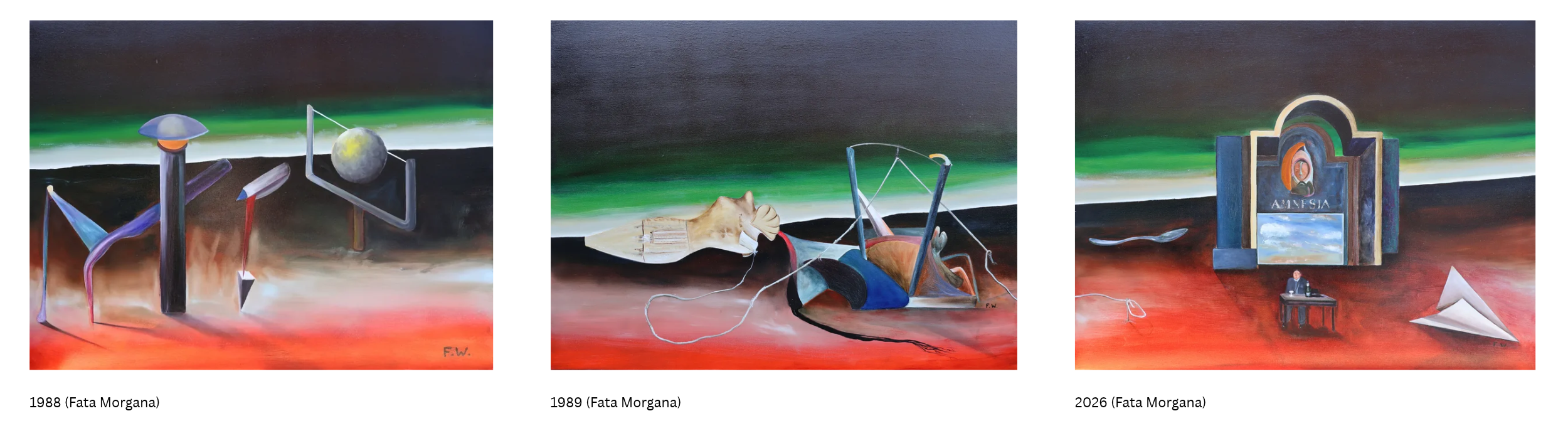
The Fata Morgana Series (1988, 1989, 2026)
Perhaps the most conceptually ambitious grouping in Werner's current output is the Fata Morgana series, a set of three paintings dated 1988, 1989, and 2026 respectively the first two years corresponding, notably, to the artist's own birth year and the year preceding it, the third projecting decades into the future. This temporal span, compressed into a single thematic series, enacts precisely the "chronological time" that Werner names among his central concerns. The title itself referencing the optical phenomenon of a superior mirage, in which distant objects appear distorted, elevated, or multiplied above the horizon operates as a sophisticated conceptual anchor: these are not paintings of fixed moments but of temporal refraction, in which past, personal origin, and speculative future are rendered simultaneously present and equally illusory.
Critically, the decision to render a biographical fact (the artist's birth year) alongside an impossible future date within a single visual series suggests a deliberate collapse of linear time into a mirage-like continuum an ambition that recalls Gerhard Richter's photo-based investigations into memory's unreliability, while retaining the more intuitive, symbol-driven vocabulary inherited from Klee and Tanguy. The series rewards sustained viewing precisely because its unity depends on the beholder's willingness to hold three temporal markers in simultaneous regard, mirroring Werner's own description of painting as a process in which meaning is only retrospectively legible to the artist himself.
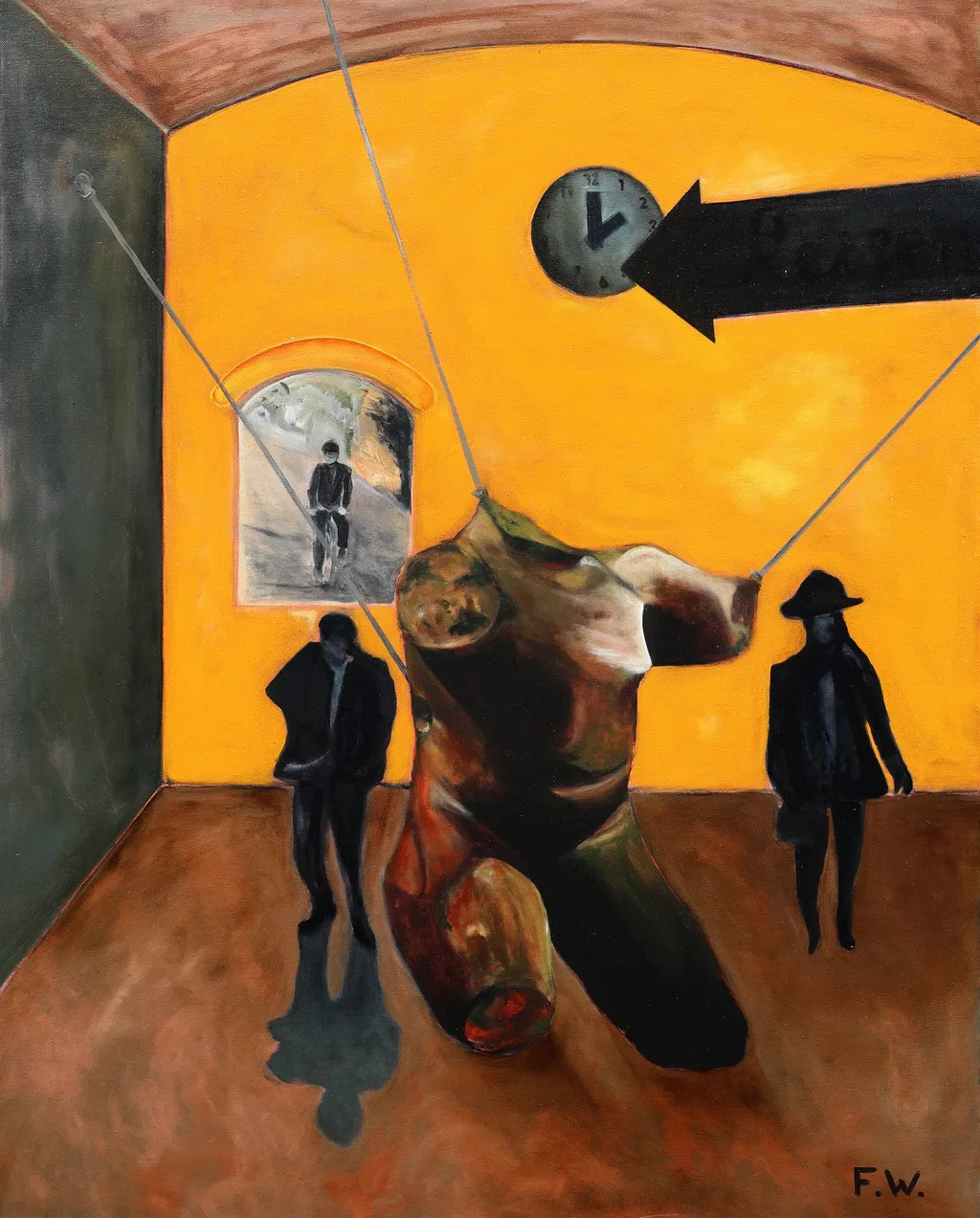
La Simulacion
Priced among the highest works in his current catalogue, La Simulacion signals its conceptual stakes directly through its title "The Simulation" an invocation that situates the work within contemporary discourse on authenticity, representation, and constructed reality. Given Werner's professed interest in the tension between control and intuition within his working process, this painting can be read as a meditation on the artist's own practice: the suspicion that any image is, by necessity, a simulation of an internal and often unconscious idea, filtered through technique and only partially under the artist's command.
This self-reflexive quality elevates the work beyond mere thematic illustration. Where a lesser treatment of "simulation" as subject might lapse into didactic commentary on digital culture, Werner's framing rooted in his own account of research, trial and error, and the slow emergence of meaning suggests a more philosophically grounded interrogation: not simulation as spectacle, but simulation as the inescapable condition of translating an abstract idea into material form.
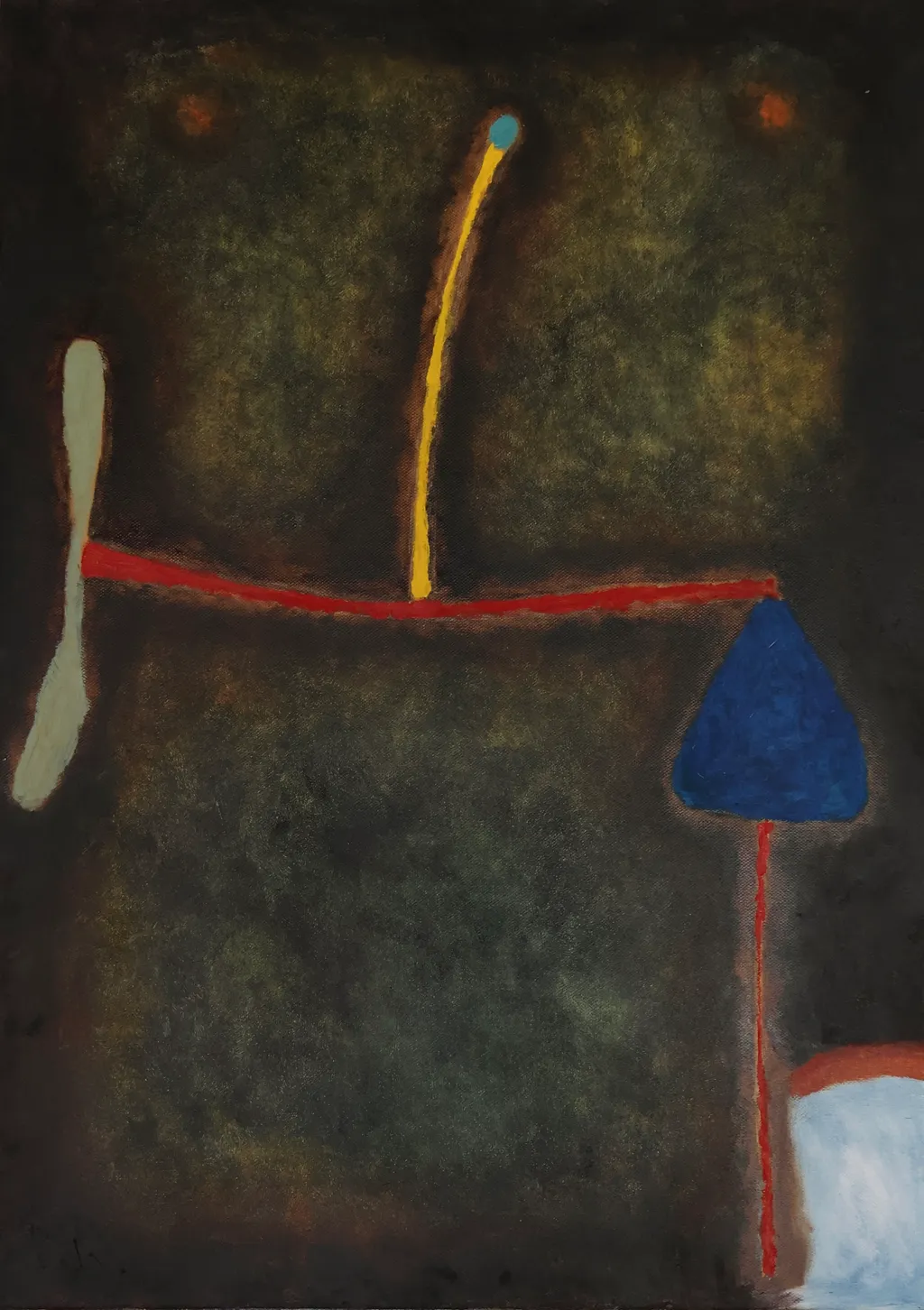
A Strategy for Happiness
Rendered in mixed media, A Strategy for Happiness occupies a tonal register distinct from the more overtly surreal works in Werner's output, its title suggesting an almost procedural, even ironic, approach to an emotion typically resistant to systematisation. This ironic distance is consistent with Werner's broader working method, in which abstract verbal prompts single words or phrases such as "Horizon" or "Two Horizons" serve as generative seeds for compositions that subsequently acquire visual and emotional complexity far exceeding their linguistic origin.
The choice of mixed media here is critically significant: unlike the oil paintings that dominate his catalogue, this work's hybrid materiality may be read as formally enacting its subject, treating "strategy" and "happiness" as composite, constructed states rather than singular emotional truths. This aligns with Werner's stated resistance to formulaic success, his professed refusal to "find a formula" that would render his creative process repetitive or commercially predictable.
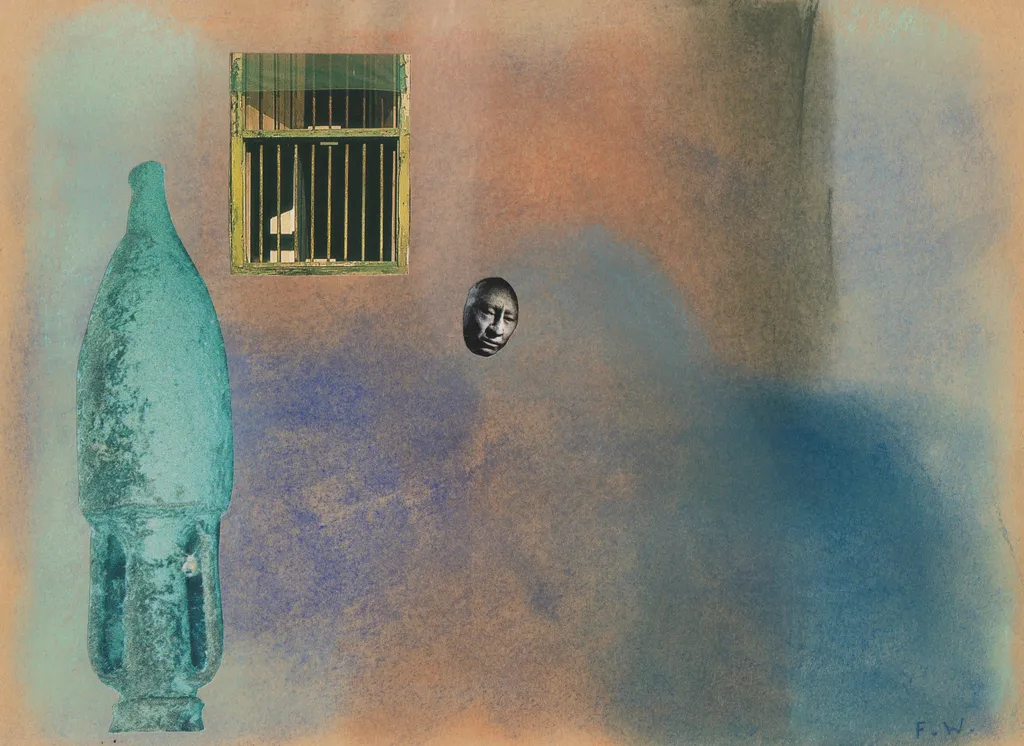
Haiku
The restraint implied by the title Haiku a reference to the compressed, image-driven Japanese poetic form suggests a conscious engagement with economy of visual language, a notable counterpoint to the denser symbolic accumulation found elsewhere in Werner's catalogue. Executed in mixed media, the work invites comparison with Klee's own interest in distilled, almost notational mark-making, in which a minimal vocabulary of forms is asked to carry significant conceptual weight.
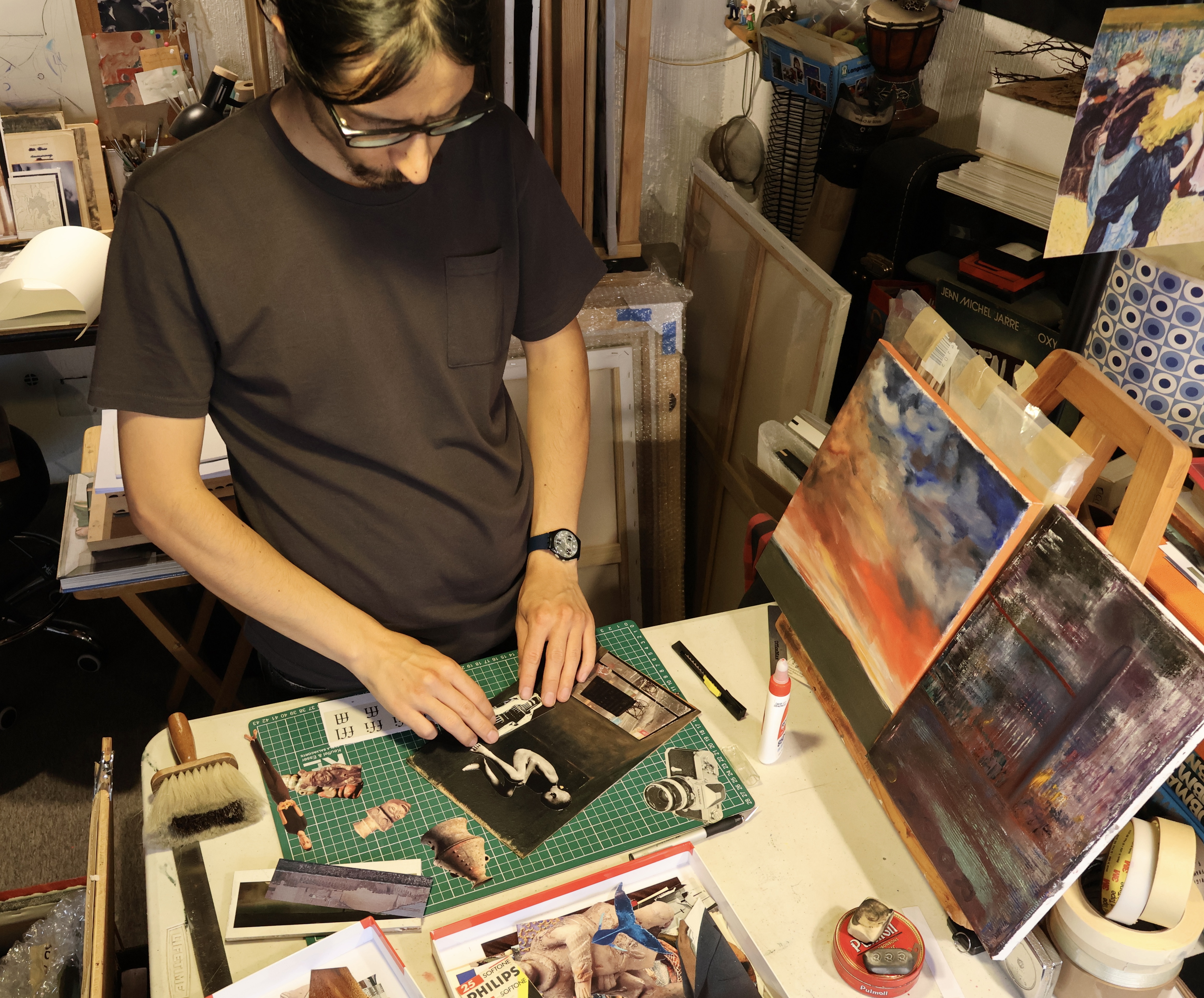
This piece also illuminates Werner's professed use of collage as a compositional tool: the clarity he seeks through collage an "instant general overview" of a painting's viability finds its logical extension in a work whose very title gestures toward brevity and precision. Haiku thus functions as a useful case study in how Werner's procedural methodology directly informs the final character of individual works, rather than remaining a backstage technical consideration invisible in the finished piece.
Suspended Ashes
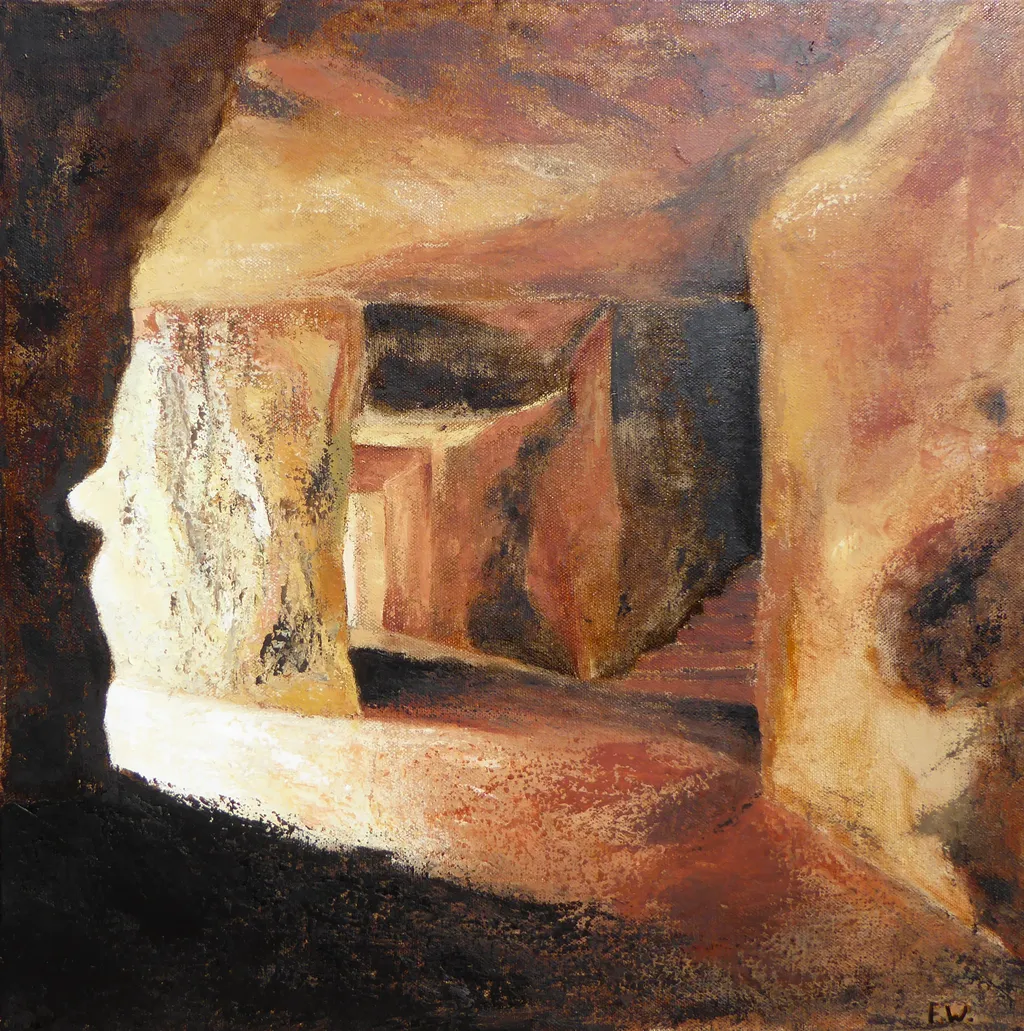
Among the mixed media works, Suspended Ashes stands out for its evocative title, which suggests both the aftermath of transformation (combustion, loss) and a state of unresolved stasis ("suspended"). This duality between destruction and arrest, between an implied past event and an ongoing present condition, exemplifies the tension Werner identifies as central to his thematic concerns. The painting's conceptual architecture mirrors his description of the creative process as one in which unfinished works are deliberately "left unattended," allowed to resolve subconsciously over weeks or months before a solution presents itself.
Read in this light, Suspended Ashes may be understood not only as a finished statement but as a visual record of the artist's characteristic method of deferral and an embrace of incompleteness as a generative, rather than merely transitional, state.
Contribution and Position Within Contemporary Practice
Werner's most significant contribution to contemporary painting may lie less in a singular stylistic innovation than in the rigour with which he has integrated a cross-disciplinary sensibility drawn from his training as a musician into a visual practice governed by recurring structural concerns: duality, tension, harmony, and the elasticity of time. His refusal to commercialise his vision through repeatable formulas, combined with a working method that balances disciplined research with deliberate surrender to intuition, positions him within a lineage of painters for whom process is inseparable from meaning.
For collectors, Werner's catalogue offers a rare opportunity to engage with a painter whose body of work functions as a sustained philosophical inquiry rather than a series of discrete, market-driven objects. The thematic coherence across series such as Fata Morgana, alongside the conceptual density of individual works like La Simulacion and Suspended Ashes, suggests an artist whose practice rewards long-term engagement and collection in depth, rather than isolated acquisition.
Those seeking to deepen their understanding of Werner's evolving practice are encouraged to explore his full portfolio on ArtRewards, where his complete body of available work spanning painting, drawing, sculpture, and mixed media offers further insight into the preoccupations outlined above.